
Resources
Understanding the Documentation Gap
What Is Baseline Wildfire Documentation?
Post-Mitigation Verification Explained
Maintaining Defensible Records Over Time
Sample Documentation Exhibit

1. Understanding the Documentation Gap
Why completed mitigation work is often undervalued during insurance review
Wildfire mitigation work is often completed with good intent and meaningful improvement. However, the documentation of that work can be fragmented, informal, or incomplete.
In many cases:
• Photographs are not clearly dated or labeled
• Before-and-after conditions are not paired
• Scope of work is not clearly summarized
• Records are stored across multiple emails, invoices, and folders
• Improvements are described but not visually verified
When underwriting or renewal review occurs, the absence of structured documentation can limit how those improvements are evaluated.
The issue is often not the work itself, but the clarity of the record.
Insurance review relies on organization and consistency. Mitigation measures may reduce exposure in practice, but without structured documentation, it can be difficult for third-party reviewers to determine:
• What was done
• When it was completed
• Where it was performed
• How it relates to wildfire exposure conditions
This documentation gap can create uncertainty during renewal or policy evaluation.
EmberReady addresses this gap by organizing observed conditions and completed mitigation into structured, insurance-ready records.
The goal is not advocacy or inspection.
The goal is clarity.
Clear documentation allows improvements to be evaluated as intended.
2. What Is Baseline Wildfire Documentation?
Establishing a structured record of observed wildfire exposure conditions
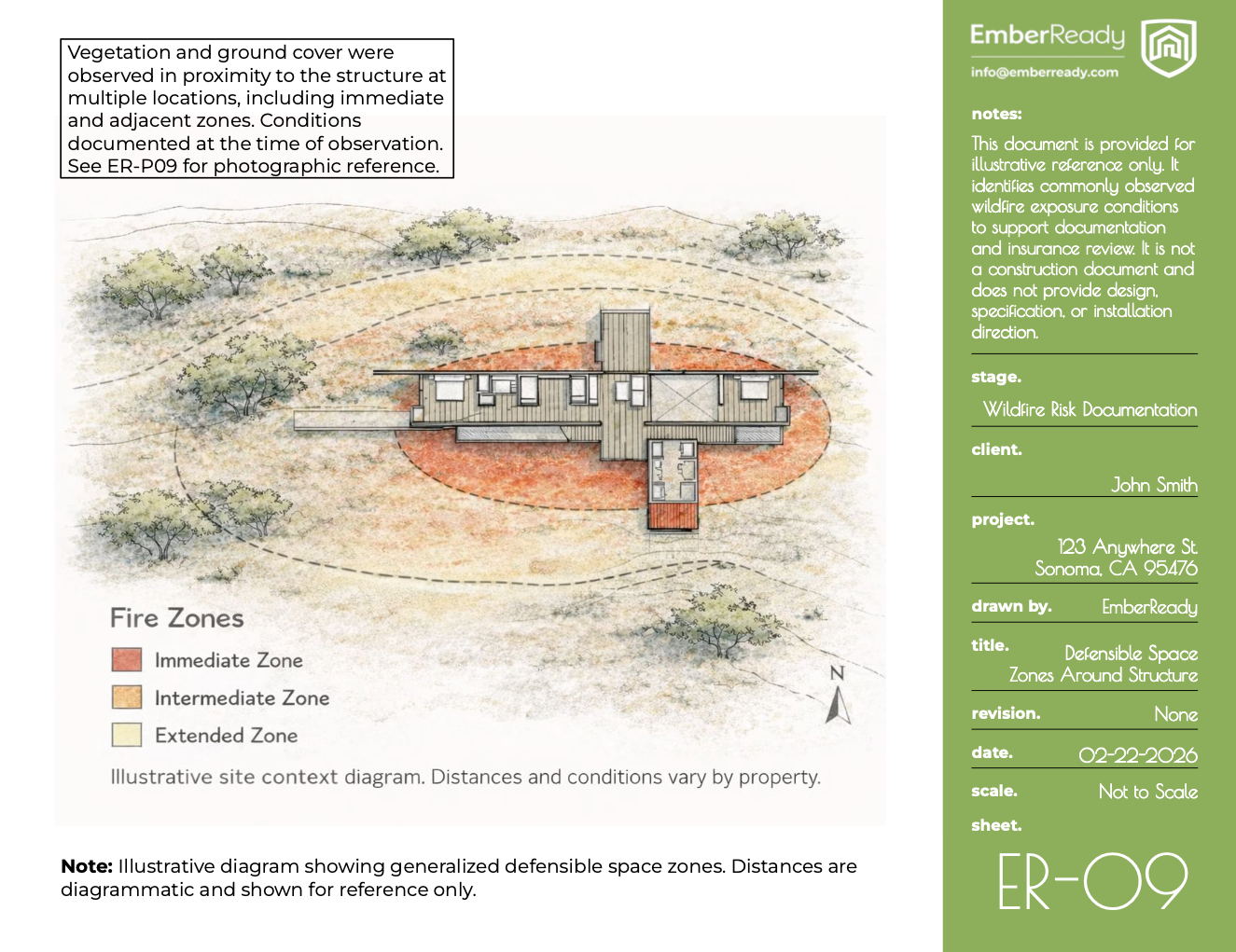
Phase 1 documentation establishes context prior to mitigation.
Baseline wildfire documentation is a structured record of observed conditions at a property at a specific point in time.
It creates an organized reference of wildfire exposure conditions, including:
• Photographic documentation of the site and structures
• Categorized condition summaries
• Location-based references
• Organized exhibits suitable for third-party review
Baseline documentation reflects existing conditions. It does not project improvements or certify compliance.
This type of documentation is especially valuable:
• Prior to insurance renewal
• When seeking new coverage
• Before mitigation work begins
• During property transfer or sale
• When formal property records are incomplete
A baseline record establishes context. It creates a defensible starting point for future improvements or verification.
Baseline documentation is not:
• A construction document
• A mitigation scope of work
• A guarantee of insurance approval
• Contractor management
• Code certification
It is a structured, observational record of conditions at the time of review.
A clear baseline provides context for all future documentation.
3. Post-Mitigation Verification Explained
Documenting completed mitigation work in a structured format
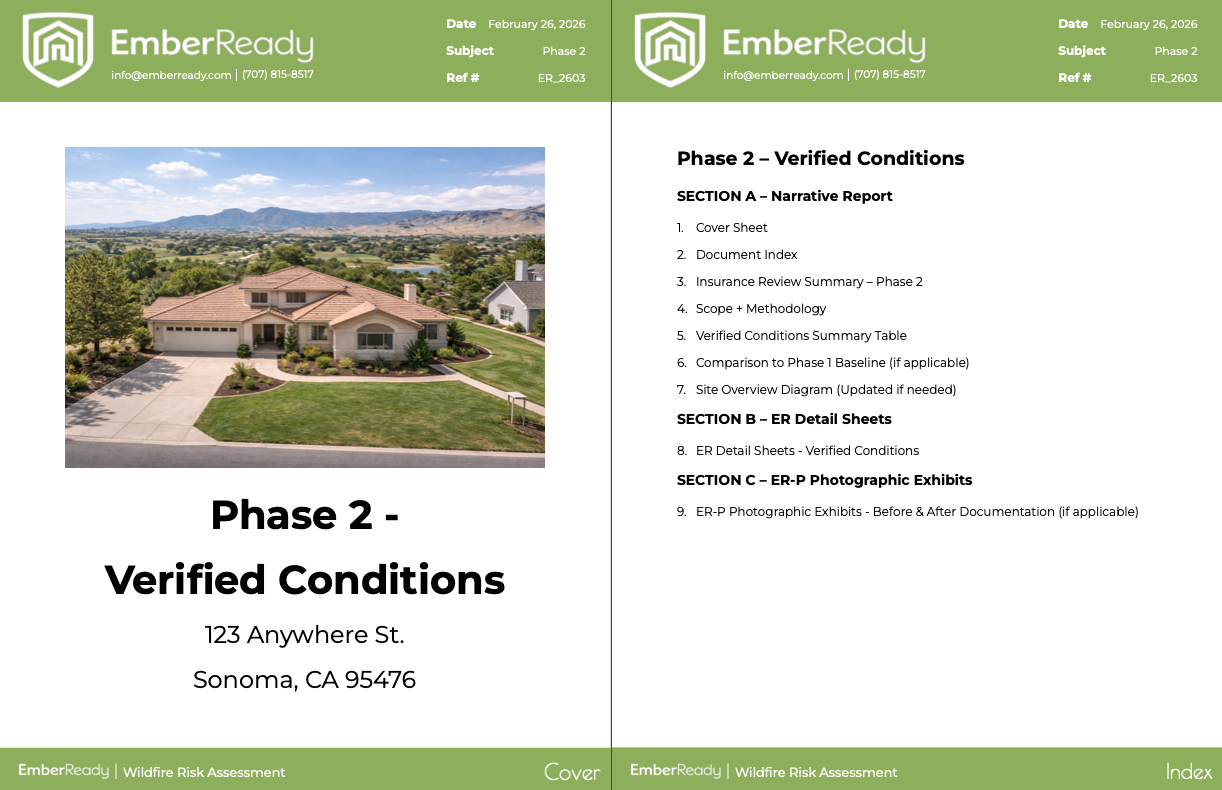
Post-mitigation verification documents completed wildfire mitigation work after installation or correction has occurred.
This process focuses on recording observed completed conditions and organizing them for clarity and insurance review.
Verification documentation may include:
• Observed confirmation of completed mitigation measures
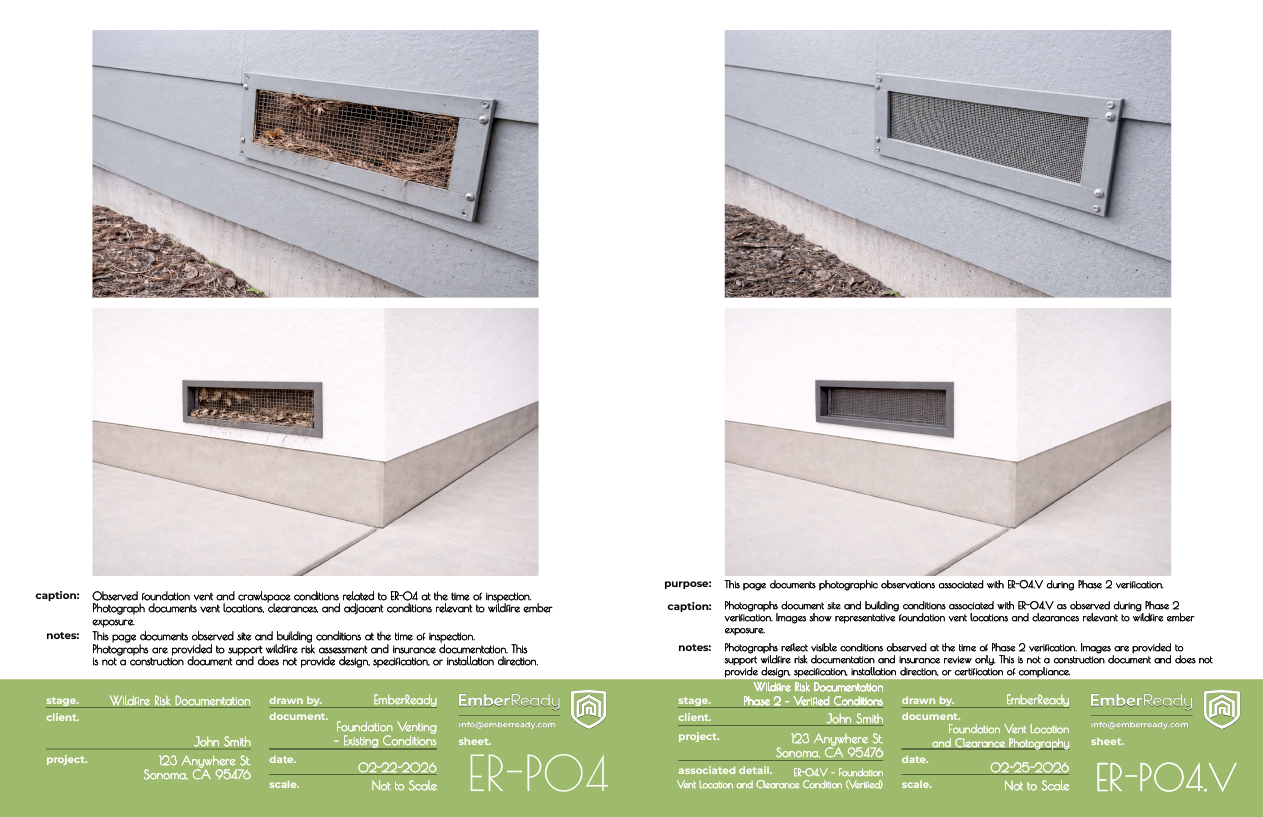
• Before-and-after photo references, when available
• Categorized condition summaries
• Updated exhibits aligned with prior baseline documentation
• Structured presentation suitable for third-party evaluation
Verification reflects observed conditions at the time of documentation. It does not supervise work, manage contractors, or certify performance.
EmberReady does not perform mitigation work or provide construction oversight. Verification is intentionally independent to maintain objectivity and defensibility.
Structured verification allows third-party reviewers to understand:
• What improvements were made
• Where they were completed
• How they relate to previously documented exposure conditions
• The condition of the property at the time of review
Clear documentation supports evaluation. It does not advocate outcomes.
Independent verification reinforces clarity and consistency in the property record.
4. Maintaining Defensible Records Over Time
Why wildfire documentation should be treated as an evolving record
Wildfire exposure conditions are not static.
Vegetation grows.
Maintenance occurs.
Improvements are made.
Ownership may change.
Documentation that reflects only a single moment may lose relevance over time.
Maintaining defensible records provides continuity between insurance cycles and creates an organized property history.
Ongoing documentation can support:
• Updated condition references
• Verification of continued maintenance
• Documentation of completed improvements
• Structured historical records
• Reduced need for reactive documentation requests
Rather than recreating records at each renewal period, documentation can evolve in a structured and consistent manner.
Periodic updates may document:
• Continued defensible space maintenance
• Replacement of materials
• Changes to vents, roofs, or attachments
• Updated property conditions
The goal is consistency, not repetition.
Structured records are most effective when maintained intentionally.
5. Sample Documentation Exhibit
Illustrative example of structured wildfire documentation
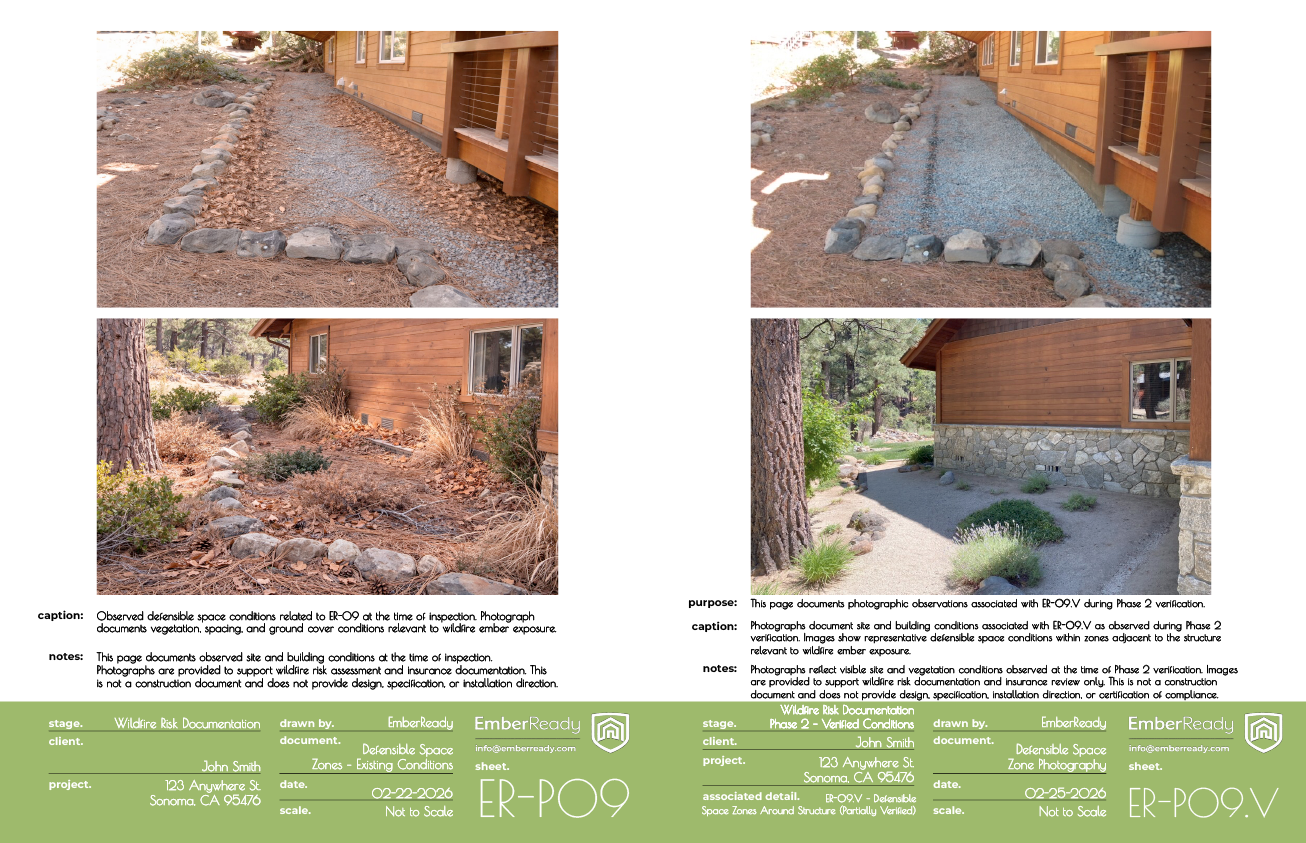
The examples on this page illustrate how wildfire exposure conditions are organized within an EmberReady documentation set.
These samples are provided for reference only and do not represent any specific property.
Structured documentation typically includes:
• Property-wide overview references
• Categorized condition exhibits
• Clearly labeled photographic documentation
• Location identifiers
• Date of observation
• Exhibit numbering for consistency
Each condition exhibit is organized to present:
• Condition identification
• Observed status at time of review
• Supporting photographs
• Reference location within the property
• Clear exhibit labeling for third-party clarity
Reports are organized into clearly labeled exhibits, such as ER-01, ER-02, and related photo pages, to maintain consistency and ease of review.
This structured format is designed to support clarity during underwriting or third-party evaluation.
The purpose of documentation is organization and transparency, not certification or determination.